

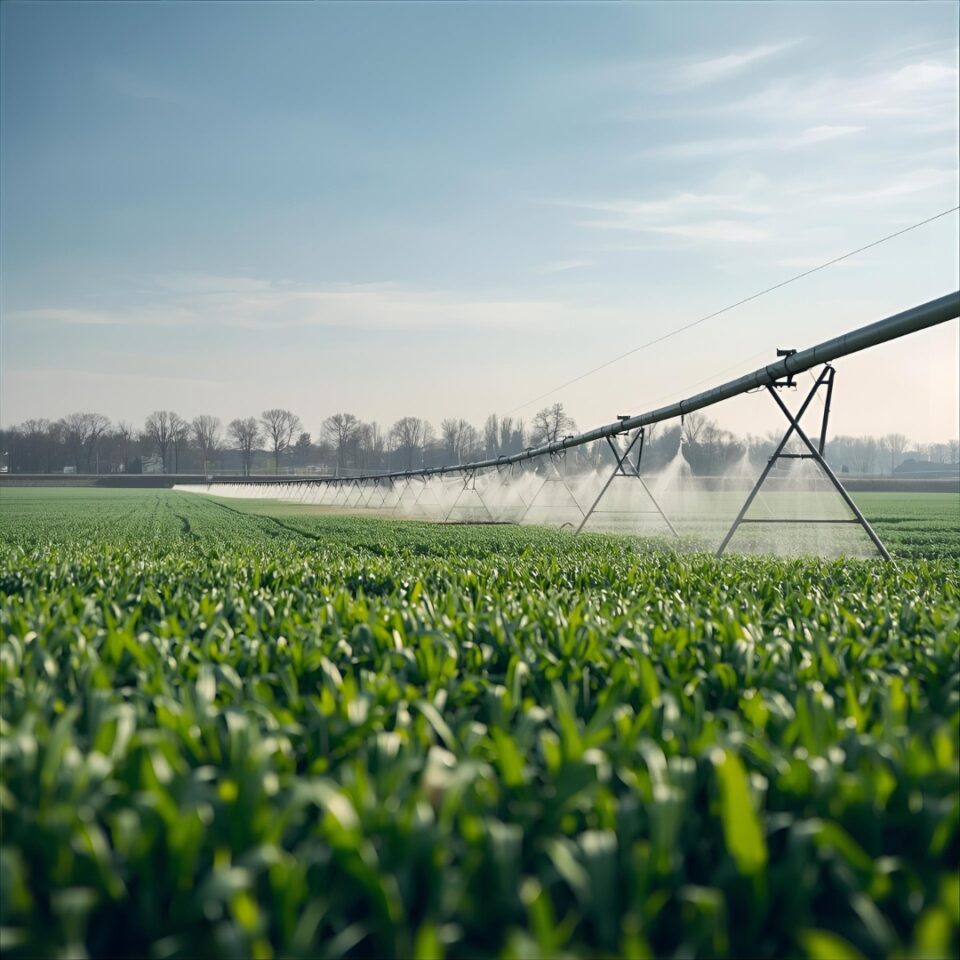
One of the main benefits of irrigation is the ability to produce crops consistently, regardless of fluctuating weather patterns. For PE Loubser Boerdery, located just outside Durbanville in the Western Cape, advanced irrigation technology from Agrico has become central to the farm’s success, ensuring reliable production even under variable climate conditions.
The Loubser family has deep roots in the Koeberg area, dating back to 1875. Today, Eduard Loubser farms alongside his father, Pieter, as part of Fair Cape Dairies, whose products are distributed widely across South Africa.
Smart Irrigation Technology
In partnership with Agrico, the farm has installed 11 pivots across 300 hectares, supported by smart control systems that tailor irrigation to the farm’s specific needs. Eduard, who has been farming for 11 years, manages the entire system through Agrico Web Control, a smartphone app that allows real-time adjustments to pressure and water flow. “It’s as easy as 1, 2, 3,” he says.
According to Johan Myburgh, Agrico’s head mechanical engineer, this technology benefits both younger and older farmers and is especially useful on uneven terrain. The system automatically adjusts motors and pumps as the towers move across the field, ensuring efficient water use without wasting energy.
Consistent Production and Crop Management
Since installing the pivots, PE Loubser Boerdery has been producing between 2,000 and 2,500 tonnes of lucerne annually, all of which is used to feed their dairy herd. The farm also produces around 10,000 tonnes of silage maize under irrigation each year, eliminating the need for outside feed purchases and supporting the farm’s cash flow.
A carefully managed rotation system ensures high-quality lucerne and grain crops. Lucerne, planted on 150 hectares of the farm, is maintained for three years, after which grains are rotated in. The grain cycle includes two years of winter wheat, supplied as a cash crop to Sasko, followed by summer maize harvested for silage. Lucerne is then re-established, completing the cycle. Lucerne produced on the farm boasts a protein content of around 25%, earning it the nickname “a bank of lucerne concentrate.”
Harnessing Grey Water for Sustainability
A unique advantage for the farm is a long-standing agreement with the City of Cape Town to use grey water from the Fisantekraal wastewater treatment plant. This plant, built between 2008 and 2010, provides a sustainable water source for the farm. Eduard explains, “This agreement dates back almost 20 years, when the municipality approached us about using the plant’s grey water, since we farm right next to it and the water couldn’t be discharged into the Mosselbank River.”
To make full use of this resource, the farm constructed a storage dam capable of holding up to one million cubic metres of water, ensuring irrigation security through the dry summer months. As Cape Town grows, the volume of grey water available to the farm continues to increase, supporting further expansion of the irrigation network.