

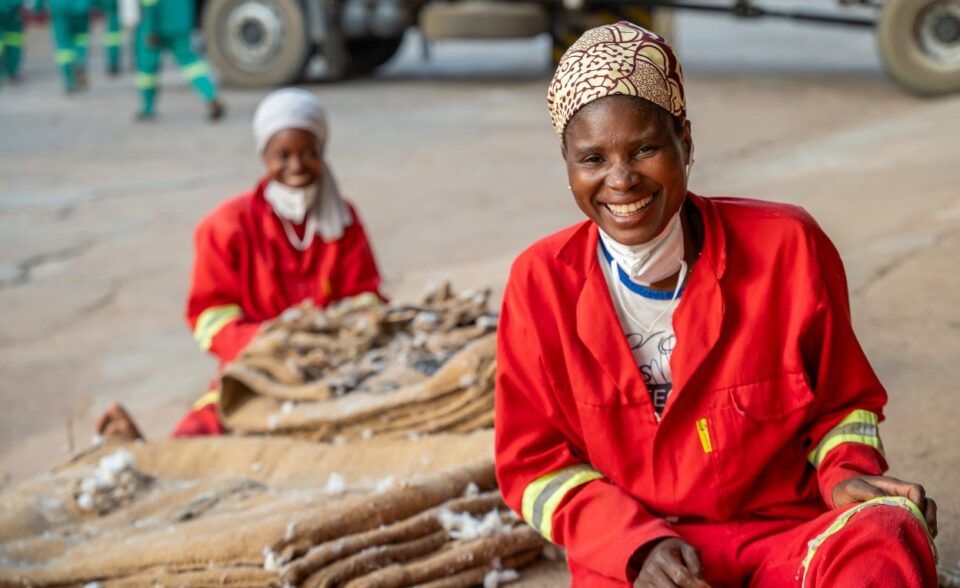
A scheme tested in Uzbekistan could allow African cotton farmers to earn twice from the same land—once from cotton production and again from the carbon stored in their soil.
Cotton has traditionally generated income only from harvested fibre. Under a new proposal from the International Cotton Advisory Committee (ICAC), farmers could also earn carbon credits by adopting regenerative farming practices that increase soil carbon.
The Washington-based organisation announced the initiative on April 30, estimating that qualifying farmers could earn up to US$200 per hectare in additional income, potentially matching crop earnings in some parts of West Africa.
To qualify, farmers would need to adopt practices such as planting cover crops, reducing ploughing and incorporating biochar—charred organic material that improves soil health while locking carbon underground for decades.
ICAC Chief Scientist Dr Keshav Kranthi said biochar improves soil structure, retains water and nutrients, promotes microbial activity and increases farm profitability.
ICAC says the initiative is primarily a soil health and regenerative agriculture programme, with carbon finance helping farmers afford long-term improvements.
“With simple techniques, cotton farmers can improve soil quality while storing carbon for more than 100 years,” said ICAC Executive Director Eric Trachtenberg.
Carbon credits generated through these practices would be sold to companies seeking to offset emissions. Similar programmes already exist in forestry. In 2025, the World Bank paid the Democratic Republic of Congo US$19.47 million for verified emissions reductions under its forest conservation programme.
However, soil carbon projects face verification challenges. Previous carbon-credit schemes lost credibility after investigations found some projects overstated emissions reductions.
To address this, ICAC has partnered with Merago, a carbon market company responsible for measuring soil carbon, monitoring participating farms, verifying results against international standards and managing certified carbon credit sales.
According to ICAC Communications Director Mike McCue, the programme is currently in its preparatory stage, with discussions underway in member countries. Initial work includes registering farmers, collecting baseline soil data, assessing available biomass, training local teams and establishing digital monitoring before independent validation.
Early estimates suggest participating farms could generate two to three carbon credits per hectare annually, depending on local conditions.
Uzbekistan was selected for the pilot because its large, state-organised farms make monitoring relatively simple. Africa presents a greater challenge, with around four million cotton-growing households, most farming only one or two hectares.
Countries including Benin, Burkina Faso, Mali and Côte d’Ivoire rely heavily on smallholder cotton production, making soil testing and verification more expensive and logistically complex. ICAC has yet to explain how farmer aggregation and upfront verification costs will be financed.
Despite these challenges, the Aid by Trade Foundation (AbTF) believes African farmers are well positioned. Its Cotton made in Africa (CmiA) programme already promotes sustainable farming practices that improve soil health and support carbon sequestration.
AbTF’s Holger Diedrich said participating farmers are already adopting many of the practices needed to generate carbon credits while reducing fertiliser costs through biochar use.
ICAC cautions that carbon credits should not be viewed as guaranteed income. The projected US$200 per hectare represents a best-case scenario, and scaling the programme will require support from governments, certification bodies and private investors.
If successful, the initiative could provide African cotton farmers with a valuable new income stream while improving soil health, strengthening climate resilience and rewarding sustainable farming practices.