

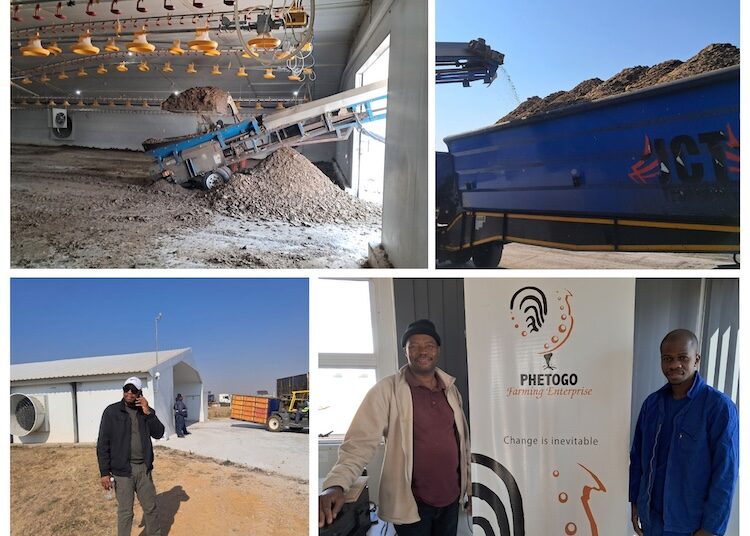
Producing nearly 900,000 broilers per cycle requires more than large poultry houses. At Phetogo Farming Enterprise in Bronkhorstspruit, technology plays a central role in monitoring environmental conditions, identifying production problems early and keeping birds on track for targeted growth. However, founder Tumi Mokwene believes that even the most advanced systems cannot replace good stockmanship.
Each poultry house at the farm accommodates approximately 45,000 broilers. Managing birds at this scale requires close control of temperature, humidity, ventilation, feed intake and water consumption.
Sensors positioned throughout the buildings feed real-time information into a computer-controlled SKOV management system, giving the production team continuous insight into flock conditions.
For Mokwene, the value of technology goes beyond collecting data. It lies in recognising changes early enough to prevent them from developing into costly production challenges.
“Technology allows us to know immediately if something is changing. If water consumption drops, if feed intake changes or if temperatures move outside the desired range, we know before it becomes a production problem.”
Using Data to Monitor Flock Performance
The system tracks daily mortalities, water intake, flock weights and other key production indicators, enabling management to monitor performance throughout the production cycle.
One of the farm’s priorities is maintaining its average daily growth targets. Environmental conditions can have a direct impact on this performance. When birds become too hot, for example, feed intake may decline, slowing growth and potentially affecting overall production results.
“At the end of the cycle you ask yourself why the birds are below standard, when the warning signs were already there,” Mokwene says.
By monitoring changes in flock behaviour and production data, the team can respond more quickly to potential problems. Environmental management therefore becomes an essential part of production efficiency, rather than simply a matter of keeping poultry houses comfortable.
Keeping Chicks Warm During Winter
Temperature control is particularly important during brooding, when newly placed chicks require carefully managed conditions to support early development.
During winter, Phetogo uses coal-fired boilers to heat water, which is circulated through insulated pipes to radiators inside the poultry houses. The system helps maintain the temperatures required by chicks during their critical first days.
Reliability is also built into the heating infrastructure. Each boiler installation has two pumps, allowing one to continue operating if the other requires maintenance.
This approach reflects a broader principle of commercial poultry management: preventive maintenance is essential to reducing operational disruptions.
“It is cheaper to maintain equipment before it breaks than to wait for a breakdown during production,” Mokwene says.
Managing Heat and Ventilation
As temperatures rise, ventilation becomes increasingly important in maintaining suitable conditions for the flock.
Fresh air enters through automatically controlled inlet vents along the sides of the poultry houses, while large extraction fans at the opposite end remove stale, humid air. Together, these components create a tunnel ventilation system designed to maintain airflow throughout the buildings.
Phetogo has also incorporated emergency roof ventilation hatches to help manage extreme heat.
During periods of high temperatures, extraction fans may struggle to remove enough hot air. Because hot air rises, the roof vents automatically open to release accumulated heat from the buildings.
According to Mokwene, this reduces pressure on the extraction fans, helps limit electricity consumption and supports more comfortable conditions for the birds.
The combination of automated environmental controls and additional ventilation capacity provides the farm with another layer of protection against temperature-related production challenges.
Why Technology Cannot Replace the Farmer
Despite its investment in automated monitoring and environmental control, Phetogo continues to place strong emphasis on physical inspections and experienced stockmanship.
Farm manager Nelson Sebetha arrives before most workers and walks through the poultry houses with a notebook, checking feed availability, water supply, ventilation, litter condition and bird behaviour.
These inspections help the team identify issues that may not be fully reflected in computer-generated data. After completing his checks, Sebetha provides the production team with instructions for the day and continues recording observations manually.
“We physically inspect the birds first. The computer is there to support us, but we never rely on it alone,” Sebetha says.
He believes that technology is most effective when combined with practical experience and an understanding of poultry behaviour.
“Technology gives us information, but you still need people who understand what they are looking at inside the house.”
Combining Technology with Good Stockmanship
Phetogo Farming Enterprise’s approach demonstrates how automated environmental controls, reliable infrastructure and hands-on flock management can work together in large-scale broiler production.
Monitoring systems provide early warnings and help the team make informed decisions, while preventive maintenance reduces the risk of equipment failures disrupting production. Regular physical inspections ensure that data is supported by direct observation of the birds.
For commercial poultry producers, the lesson is clear: technology can improve visibility, consistency and responsiveness, but successful production still depends on people who understand the flock.
At a scale approaching 900,000 broilers per cycle, the combination of reliable systems, timely intervention and good stockmanship remains central to maintaining bird welfare and production performance.