

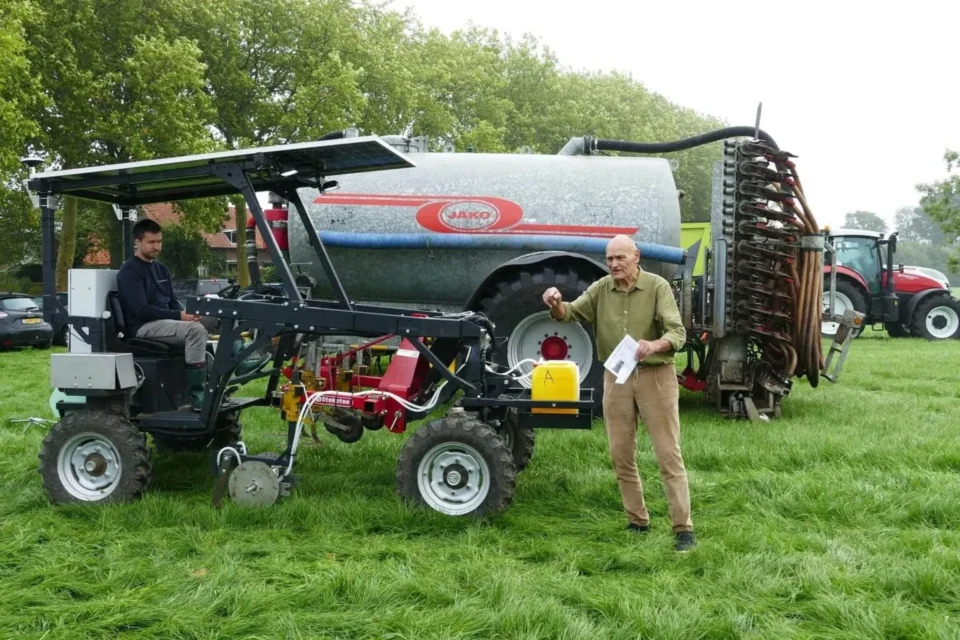
A lightweight disc applicator designed to place liquid fertiliser directly into the crop root zone could offer a new approach to precision nutrient application. A prototype has been demonstrated in the Netherlands, with the potential to form the basis of an autonomous fertilisation robot. However, automated driving and refilling systems still need to be developed.
The concept was presented on 11 September in Zwartebroek, Gelderland, during a demonstration day organised by Coöperatie Gelderse Vallei Kunstmestvrij.
The technology uses discs to drive a roller pump that doses liquid fertiliser as the machine moves. This simple mechanical arrangement links the applicator’s movement to fertiliser delivery, allowing nutrients to be placed directly into the soil rather than spread across the surface.
For African agriculture, the concept raises an important question: could lightweight, precision fertilisation equipment help farmers improve nutrient placement while reducing reliance on heavier machinery? Its suitability would depend on local soil conditions, crop requirements, operating costs and the availability of appropriate liquid fertilisers.
Lightweight Mechanisation and Electric Power
Herre Bartlema, chairman of the Dutch Centre for the Development of Circular Precision Fertilisation (NCOK), sees potential to integrate the technology into a lightweight, electrically powered autonomous vehicle.
The prototype demonstrates how liquid fertiliser can be applied using a relatively simple mechanism without requiring a heavy machine. However, a fully autonomous fertilisation robot is still a concept under development.
Automated refilling could be another feature. A docking station could allow the machine to replenish its fertiliser supply before returning to the field. The design and practical implementation of this system have yet to be established.
For African farmers, the broader relevance lies in the development of mechanisation solutions that match farm size, available infrastructure and operating budgets. Whether this particular technology could be adapted for smallholder farms or larger commercial operations remains to be tested.
Targeted Fertiliser Application in the Root Zone
Bartlema has long promoted precision fertilisation and emission reduction. He expects RENURE fertilisers to provide a significant supply of readily available liquid nutrients that can be applied directly to the root zone when crops need them.
The disc applicator follows this principle by placing liquid fertiliser into the soil rather than distributing it over the surface. More targeted application could improve nutrient placement and potentially reduce losses, although these benefits would need to be verified through agronomic trials.
In African farming systems, where fertiliser affordability and efficient nutrient use are important considerations, technologies that improve the placement and timing of fertiliser applications are worth monitoring. Their value will ultimately depend on measurable improvements in crop performance, nutrient-use efficiency and overall production costs.
Performance, Cost and Adaptation Remain Key Questions
The technology still requires further development before it can become a practical autonomous fertilisation machine. Important technical details, including working width, tank capacity, operating speed, field capacity and dosing accuracy, have not yet been reported.
Its performance under different soil conditions also needs to be assessed. For African applications, additional considerations would include operating in varied soil types, coping with local field conditions, accessing suitable liquid fertilisers and ensuring that maintenance and operating costs are manageable.
The prototype offers a glimpse of how simple mechanical engineering could support the development of precision fertilisation and agricultural robotics. The next step is to establish whether the concept can deliver reliable field performance at a cost that makes practical and economic sense for farmers.
For African agriculture, the technology is one to watch as the sector explores more efficient nutrient management, appropriate mechanisation and the future role of automation on farms.