

SKF has successfully implemented an advanced condition monitoring (COMO) solution at one of Tunisia’s leading food processing companies, providing real-time visibility into the health of critical machinery. The project marks an important step in the customer’s transition from reactive maintenance towards data-driven decision-making and predictive asset management.
As food and beverage manufacturers face increasing pressure to maximise equipment availability, control operating costs and improve production efficiency, reliable maintenance strategies have become essential. Unplanned equipment failures can disrupt production, compromise product quality and negatively affect profitability. For manufacturers operating in competitive markets, relying solely on reactive maintenance is no longer a sustainable approach.
The ability to monitor equipment condition continuously, identify developing faults and make informed maintenance decisions is becoming increasingly important to long-term operational performance.
“The journey towards smarter maintenance begins with visibility,” says Marwen Chebbi, Sales Manager at SKF Tunisia. “SKF’s COMO solutions play a pivotal role in helping industries transform machine data into actionable intelligence, supporting the transition towards predictive maintenance strategies that enhance asset reliability, improve operational performance and deliver measurable business value.”
A Long-standing Partnership Built on Reliability
SKF’s relationship with the Tunisian food processing company dates back to the establishment of the business. Over the years, SKF has supplied bearings, maintenance tools, lubrication solutions and offline condition monitoring services, establishing a strong foundation of technical expertise and operational understanding.
The latest project gained momentum towards the end of 2025, following discussions initiated through SKF’s condition monitoring (COMO) training programme in South Africa.
As part of the implementation process, SKF conducted a comprehensive site assessment in May 2026. The assessment focused on connectivity requirements, cable routing and the identification of optimal monitoring points to ensure the proposed solution would integrate effectively with the customer’s existing operations.
At the time, the customer relied exclusively on offline condition monitoring. The primary objective was therefore to strengthen its existing reliability programme by introducing continuous machine health monitoring.
SKF’s team evaluated the available hardware and software options to identify a solution aligned with the customer’s operational requirements, with a focus on anticipating equipment failures, improving maintenance planning and protecting production continuity.
“Drawing on our process knowledge, the expertise of our authorised distributor, Équipement Moderne, and close collaboration with the customer through multiple site visits, we worked together to identify the solution with reliability, local support and long-term customer value at the centre of every decision,” explains Chebbi.
Moving from Periodic Inspections to Continuous Monitoring
Installation commenced at the end of June 2026, with SKF working alongside Équipement Moderne and the customer’s IT team.
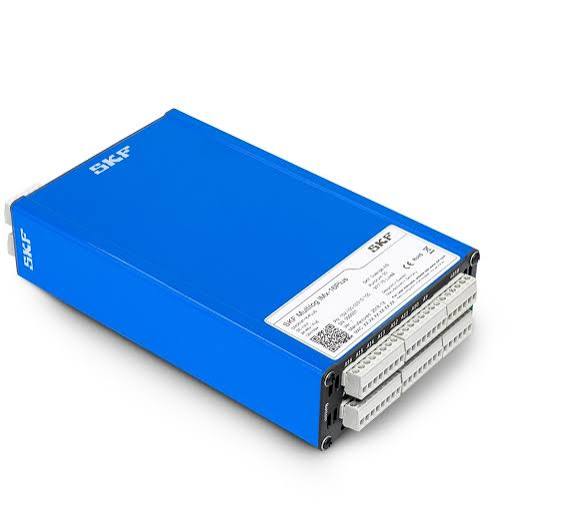
The project involved the installation of eight SKF IMx-16 units, monitoring 13 geared motors through 52 vibration sensors. This configuration provides continuous insight into equipment condition and performance, supporting the early identification of developing mechanical faults.
One of the most significant benefits of the solution is the transition from periodic inspections to continuous condition assessment.
Automated alarms and real-time machine data enable abnormal operating conditions to be identified earlier, giving maintenance teams the opportunity to investigate potential problems and plan interventions before failures disrupt production.
However, the value of the implementation extends beyond monitoring hardware. The solution also incorporates vibration analysis expertise, customer skills development and SKF’s @ptitude software platform, which provides ongoing access to vibration and temperature data.
The customer can perform first-level condition analysis independently, while SKF remains available to provide advanced diagnostics, technical reporting and maintenance recommendations when more detailed investigation is required.
“This combination of technology, expertise and knowledge sharing replaces reactive decision-making with actionable insight, empowering maintenance teams to make confident, data-driven decisions that improve reliability and asset performance,” emphasises Chebbi.
Scalable Technology and Stronger Local Support
Despite the complexities of the installation environment, SKF successfully delivered a condition monitoring solution that provides continuous asset intelligence while strengthening local technical capabilities and project execution experience.
An additional advantage is the scalability of the system. The installed infrastructure creates opportunities for future expansion, allowing further critical assets to be incorporated through additional measurement points and monitoring solutions, including SKF IMx-16 and IMx-1 technologies.
Building on the customer’s existing vibration analysis capabilities, developed through previous training initiatives and practical experience, SKF will continue supporting greater operational independence through knowledge transfer and advanced training in both offline and online condition monitoring technologies.
“Moving to online condition monitoring was a natural next step in the customer’s reliability journey,” explains Chebbi.
“Our approach is built on three pillars: customer autonomy, local distributor support and SKF expertise. The customer manages its local @ptitude platform and conducts its own first-level analysis. When deeper investigation is required, SKF provides advanced diagnostics, reporting and recommendations, while Équipement Moderne offers local support for sensors, IMx hardware and system-related requirements.”
Chebbi also highlights the important contribution of Équipement Moderne throughout the project. The distributor received specialised training in SKF’s condition monitoring and COMO solutions, strengthening its ability to provide effective local technical support.
This collaborative approach combines customer competence, distributor proximity and SKF’s technical expertise, creating a sustainable framework for long-term reliability improvement and continuous skills development.
Building a More Proactive Maintenance Culture
The successful implementation demonstrates how technology, technical expertise and close customer collaboration can deliver measurable operational value.
By combining its food and beverage industry strategy with distributor development, opportunity identification and ongoing technical support, SKF has strengthened the customer’s confidence in its maintenance capabilities while establishing a foundation for further reliability improvements.
For Chebbi, the project’s significance extends well beyond the installation of 52 monitoring points.
“Our approach was never simply to supply a condition monitoring system. It’s about helping our customer build a stronger maintenance culture and a more proactive approach to asset management.”
The objective was to improve machine reliability, equipment availability and overall operational performance while safeguarding production continuity through earlier fault detection and better maintenance planning.
The journey began with offline condition monitoring, progressed through skills development and has now advanced to continuous online monitoring. The result is a scalable platform capable of evolving alongside the customer’s future operational requirements.
Ultimately, the project demonstrates how SKF technology, local distributor support and customer commitment can work together to transform maintenance practices, enable more informed decisions and strengthen the long-term reliability of critical production assets.