

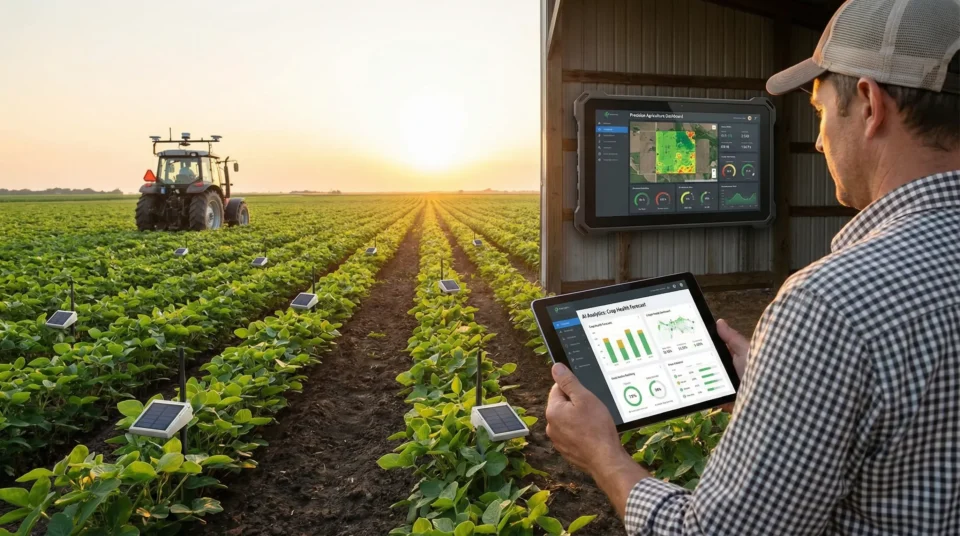
As Africa faces increasing pressure to boost food production while managing limited natural resources, innovative digital farming solutions are emerging as powerful tools to support agricultural transformation. A new Internet of Things (IoT)-powered precision agriculture platform is now offering farmers across Sub-Saharan Africa access to data-driven technologies designed to improve productivity, resource efficiency, and long-term sustainability.
Developed with African farming conditions in mind, the MBS SmartFarm Platform has been introduced as a precision agriculture solution tailored for emerging farmers, agricultural cooperatives, community food production initiatives, and development-focused agricultural programmes. The platform recently completed a three-month applied research pilot at the Sustainability Institute in Lynedoch, Stellenbosch, where it demonstrated significant potential to improve farm management and resource utilization.
The pilot project focused on monitoring critical agricultural indicators, including soil moisture, pH levels, electrical conductivity, temperature, water consumption, and real-time weather conditions. By providing continuous access to field data, the system enabled more informed decision-making and contributed to noticeable improvements in soil health management and water-use efficiency within the institute’s community garden.
For Africa, where climate variability, water scarcity, and declining soil fertility continue to threaten agricultural productivity, access to real-time farm intelligence could play a crucial role in strengthening food systems and improving resilience among smallholder farmers. Precision agriculture technologies have historically been more accessible to large commercial farming operations, but platforms such as MBS SmartFarm seek to bridge that gap by bringing advanced digital tools to underserved farming communities.
Another distinguishing feature of the platform is its built-in cybersecurity architecture. As agriculture becomes increasingly digitized, protecting farm data and connected systems is becoming an important consideration. The platform has been designed with enterprise-grade cybersecurity embedded into its core infrastructure, helping safeguard information while enabling secure adoption of smart farming technologies.
According to the Sustainability Institute, integrating digital agriculture into community farming projects also creates valuable opportunities for practical learning and innovation.
“The integration of smart agriculture technologies within our garden is not only about improving yields and resource management but also about creating opportunities for experiential learning and turning the garden into a living laboratory for agricultural innovation,” said Mulweli Nethengwe, Research and Strategy Analyst at the Sustainability Institute.
The developers believe the platform has the potential to make a meaningful contribution to Africa’s food security agenda by helping farmers better understand and manage one of their most valuable assets—soil health.
“Soil health forms the foundation of sustainable food production, yet the tools required to monitor and protect it have often been inaccessible to the farmers and communities that need them most,” said Tandi Rouse, Co-Founder and Director of MyBitSecure Technologies.
She added that the platform has been specifically developed to address African agricultural challenges, providing evidence-based solutions that support stronger, more resilient food systems across the continent.
As governments, development agencies, and private-sector stakeholders continue investing in agricultural modernization, technologies such as IoT-enabled precision farming could become increasingly important in helping Africa meet rising food demand, improve climate resilience, conserve water resources, and support the growth of sustainable agricultural enterprises.
With the continent’s population expected to continue growing rapidly over the coming decades, digital agriculture solutions that empower farmers with real-time information may prove essential in building a more productive, resilient, and food-secure Africa.