

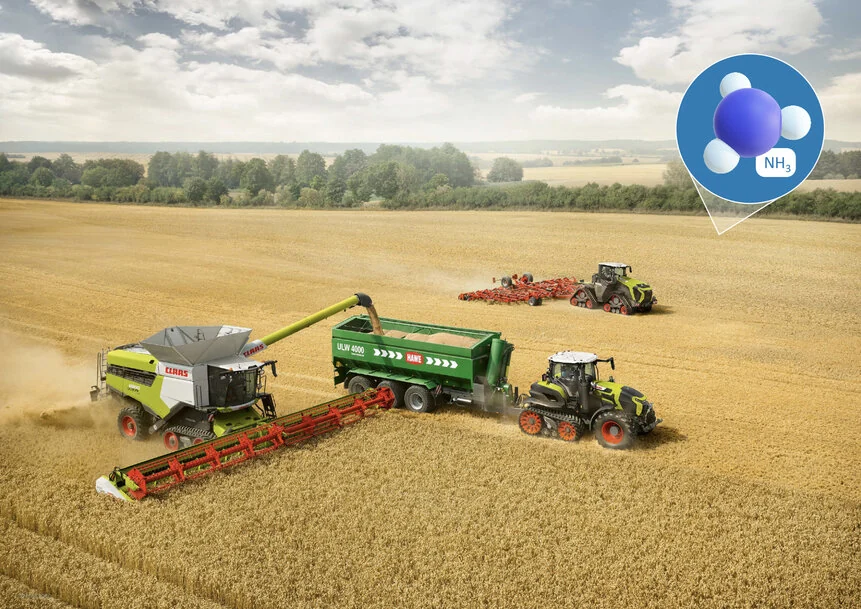
Agricultural machinery manufacturer CLAAS has joined forces with engine developer MAN Engines and research institute WTZ Roßlau to investigate ammonia-powered internal combustion engines as a potential solution for decarbonising heavy-duty agricultural machinery.
The collaboration forms part of the Green Ammonia Multifuel Combine research project, which aims to assess the technical and operational feasibility of using ammonia as an alternative fuel for high-performance tractors and combine harvesters.
The initiative seeks to explore a lower-carbon alternative to conventional diesel power without depending on the onboard storage requirements associated with pure hydrogen systems.
Addressing the Energy Demands of Heavy Agricultural Machinery
Large agricultural machines, particularly combine harvesters and high-horsepower tractors, operate under demanding conditions. Extended working hours, continuous high loads and intensive harvesting cycles require reliable power and high energy availability.
Although battery-electric drivetrains and alternative fuels are gaining momentum, meeting the energy demands of heavy agricultural equipment remains a significant challenge.
Hydrotreated vegetable oil (HVO) and biodiesel offer potential near-term alternatives because they can be used in compatible existing engine technologies. However, the development of additional low-carbon energy pathways remains important for the long-term decarbonisation of agricultural operations.
Hydrogen combustion presents another potential solution, but onboard storage requirements, high-pressure systems and packaging constraints create challenges for agricultural machinery.
Ammonia offers an alternative approach. As a carbon-free molecule, it produces no direct carbon dioxide from the fuel during combustion. It also has a higher volumetric energy density than compressed hydrogen and can be stored and transported as a liquid under appropriate conditions.
However, ammonia combustion introduces its own engineering challenges, including combustion stability, fuel handling, potential ammonia slip and the need for effective exhaust after-treatment systems.
Engine Development and Technology Integration
The Green Ammonia Multifuel Combine project brings together the expertise of three partners, with responsibilities spanning research, engine development and vehicle integration.
WTZ Roßlau leads the consortium and coordinates the research programme. The project receives €3.2 million in funding through Germany’s 8th Energy Research Programme, administered via Forschungszentrum Jülich.
MAN Engines and WTZ Roßlau are responsible for engine development and fuel-system calibration. Their work focuses on optimising ammonia combustion, improving engine performance and addressing emissions challenges, particularly unburned ammonia in the exhaust.
The development programme also includes research into suitable selective catalytic reduction (SCR) systems and other exhaust after-treatment technologies.
CLAAS is responsible for integrating the powertrain into agricultural machinery at its facility in Harsewinkel, Germany. This involves adapting the vehicle architecture, including chassis packaging, cooling systems, vibration management and onboard safety measures for ammonia storage and handling.
Project Timeline and Performance Evaluation
The research project runs from 1 May 2026 to 31 October 2029. During this period, the partners will evaluate the complete energy pathway, from the production of synthetic green ammonia to its conversion into mechanical power.
Testing will examine engine thermal efficiency, transient response, fuel consumption and overall performance under demanding agricultural operating conditions.
Particular attention will be given to whether ammonia-powered engine configurations can deliver the torque characteristics and sustained power output required during harvesting operations.
The results will also be assessed against established diesel engine performance benchmarks and applicable emissions requirements for off-highway machinery.
CLAAS Highlights the Potential of Alternative Fuels
Dr Martin von Hoyningen-Huene, Executive Vice President of the Tractor Business Unit at CLAAS, emphasised the importance of exploring different energy solutions for agricultural machinery.
He noted that high-performance equipment, particularly large tractors and combine harvesters operating at full load, is likely to continue relying on energy-dense liquid fuels in the near future.
He also highlighted HVO and, where appropriately approved, B100 biodiesel as practical alternatives that can make use of largely existing engine technology and infrastructure. While hydrogen presents additional technical challenges, ammonia could offer another pathway worth investigating.
According to CLAAS, the objective is to gain a better understanding of both the opportunities and limitations of ammonia-powered engines.
Exploring a New Pathway for Agricultural Decarbonisation
The Green Ammonia Multifuel Combine project represents an important research step towards diversifying energy sources for heavy agricultural machinery.
Although significant technical challenges remain, ammonia could provide an additional option for applications where battery-electric systems face limitations in energy capacity, operating duration and vehicle integration.
The project’s findings will help determine whether ammonia-powered internal combustion engines can deliver the performance, reliability, safety and emissions characteristics required for demanding agricultural operations.
Ultimately, the research could contribute to a broader portfolio of alternative propulsion technologies, supporting the transition towards more sustainable and energy-efficient agricultural machinery.