

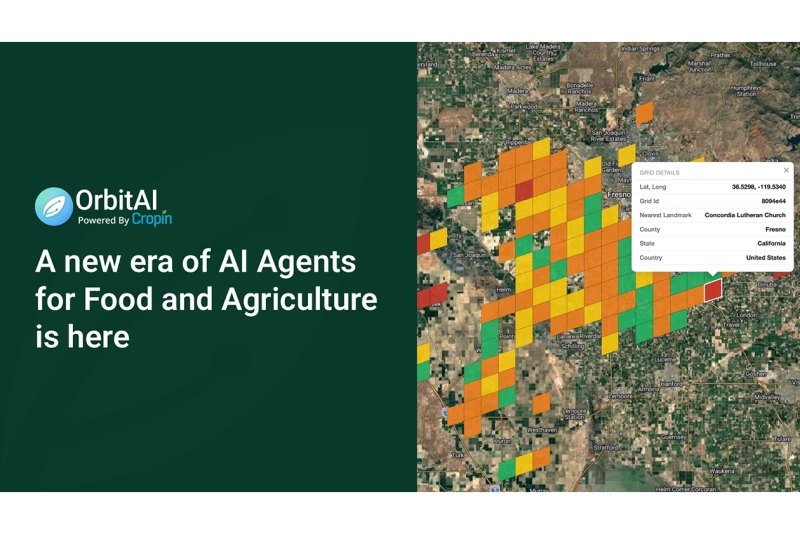
Artificial intelligence is being used to help make the crop input supply chain more predictive, giving seed and agricultural input companies earlier insights into crop conditions, disease risks, harvest timing and expected yields.
Cropin, an agricultural technology company, is applying its Orbit AI platform to these challenges. Built on Google’s Gemini technology, the platform uses field-level agricultural data to generate insights intended to help input companies and agronomists make more informed decisions.
Cropin CEO Krishna Kumar said the technology is designed to address information gaps that can make agricultural supply chains reactive rather than predictive.
According to Kumar, Orbit AI can help companies assess crop production, disease pressure and climate-related risks when planning market expansion, inventory and input distribution.
For example, companies entering a new geographic market can use agricultural data to identify areas where particular crops are being produced, examine historical yields and disease pressures, and assess potential demand for seeds or crop protection products.
AI for seed production and planning
Cropin is also applying the technology to seed production, where companies traditionally maintain inventory buffers to account for uncertainty during growing seasons.
Kumar said predictive insights could help companies improve supply-and-demand planning and potentially reduce the amount of excess inventory they need to maintain.
The technology can also provide data that may support decisions around seed development. Agricultural companies could analyse signals such as drought conditions, disease prevalence and water availability when evaluating the need for varieties with specific characteristics.
Supporting agronomists with AI
The platform is also designed to support agronomists working directly with growers.
Kumar said an agronomist may be responsible for dozens of growers, making it difficult to monitor every field manually. Orbit AI can prioritise farms based on indicators such as water stress, crop health and nutrient uptake.
The platform can then help agronomists determine which growers may require attention and organise their activities based on identified risks.
Cropin says the system can also provide estimates of upcoming harvests and expected yields. According to Kumar, some users can receive yield estimates up to 60 days in advance, potentially helping food and agricultural companies plan sourcing, purchasing and logistics.
The technology can also account for weather-related changes that could cause crops to mature earlier or later than expected.
Human oversight remains important
Cropin emphasises that the AI is intended to identify potential problems rather than replace agronomic decision-making.
For example, if the system identifies an area where nutrient uptake appears to be declining, an agronomist can inspect the field and determine the appropriate response.
Kumar said the platform does not prescribe the treatment or application rate. Instead, it provides information that can support the agronomist’s decision.
He said the company’s reported model accuracy varies between 85% and 95%, while acknowledging that AI systems cannot be expected to be completely accurate.
From agricultural data to agentic AI
Cropin began by developing digital tools for agricultural supply chains, including grower networks, agronomy, climate and disease-risk analysis.
The company says its technology is now used across 103 countries and covers 400 crops and 10,000 varieties.
Cropin has subsequently expanded into generative and agentic AI. Kumar said the company previously developed a lightweight agricultural language model based on an open-source Mistral model, which was fine-tuned using agricultural data from the Global South.
This work contributed to the development of Orbit AI, which runs on Google’s Gemini and uses an MCP server architecture. According to Cropin, the architecture provides flexibility to use different AI models and can support deployment within a customer’s own environment where required.
The company is positioning the platform as a domain-specific AI system for agriculture and food supply chains, with applications ranging from crop monitoring and agronomy to yield forecasting, sourcing and inventory planning.
As agricultural supply chains become increasingly data-driven, technologies such as agentic AI could play a growing role in connecting field-level information with decisions around inputs, production, procurement and logistics.