

You’re paying for unlimited LTE 4G or 5G—but your calls drop, WhatsApp messages stall, and your “fast” data crawls. Welcome to reality in South Africa, where glossy network coverage maps promise connection, yet inside your home, office, or warehouse, the signal vanishes. Businesses lose revenue. Home offices struggle. Emergency calls risk failure. Millions continue waiting for towers to solve a problem that exists everywhere—but not on paper.
The truth is uncomfortable: your mobile network works for everyone… except you. Until you take control, weak signal, dropped calls, and slow mobile data aren’t mere annoyances—they’re invisible taxes on your time, money, and productivity.
A Structural Issue, Not a Temporary Glitch
Urban densification, reinforced concrete, energy-efficient glass, steel roofing, rolling blackouts, and distance from towers have created a silent productivity tax. In rural South Africa and parts of Botswana, the problem is even more pronounced: coverage exists on paper, but real-world indoor performance often collapses. The result is lost revenue, frustrated customers, operational inefficiencies, and reliance on unstable alternatives like WiFi calling, which fails when power or fibre goes down.
Why Network Coverage Maps Lie
Mobile operators optimize for population density, not individual buildings. Signals that appear strong outdoors can degrade by up to 90% indoors, particularly in warehouses, factories, malls, office parks, hospitals, estates, and modern homes. Load shedding worsens the situation, causing congestion spikes and signal collapse exactly when connectivity is needed most. In Botswana, vast distances, sparse tower networks, and challenging terrain mean even premium mobile packages often fail indoors.
Waiting for networks to fix this is not a strategy. Businesses and households must take control of their own connectivity.
Mobile Signal Boosters: From Niche Tech to Essential Infrastructure
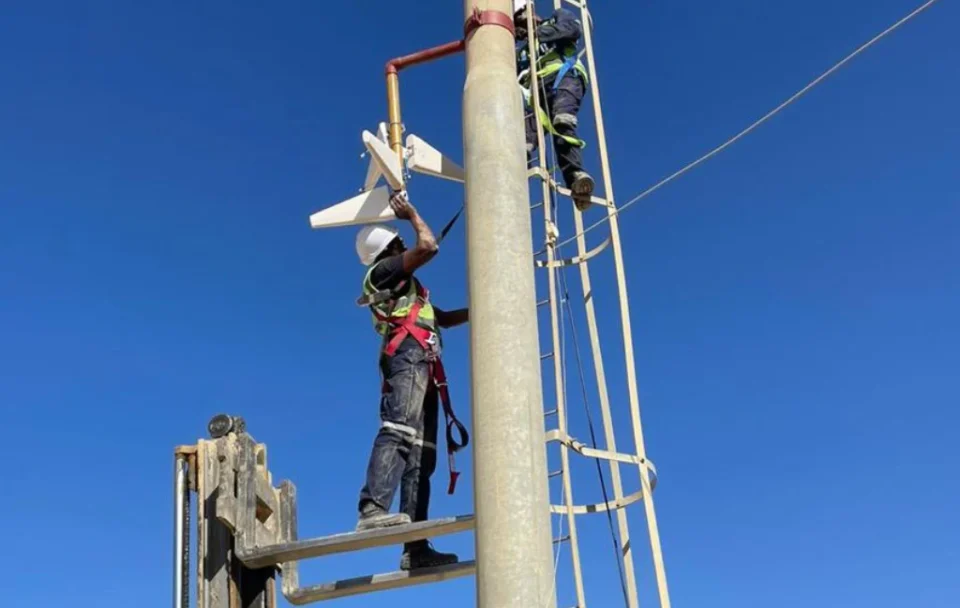
A mobile signal booster—also called a cellphone or network booster—is not a consumer gadget. Properly engineered and installed, it is a regulated, carrier-approved system that captures outdoor signal, amplifies it, and redistributes it indoors at stable, usable levels.
This technology doesn’t replace mobile networks—it enhances them. For businesses, it means uninterrupted calls, faster data, reliable POS systems, cloud access, and better customer experience. For households, it delivers clear calls, dependable 4G/5G data, stable home offices, and peace of mind in emergencies.
Why Professional Systems Matter
The market is flooded with cheap, imported signal boosters that promise results but often fail, interfere with networks, or are illegal. Professional systems are different. They begin with proper signal assessments, consider building materials, network compatibility, coverage area, and future scalability, and use ICASA-compliant, carrier-approved equipment installed with precision.
This is where Booster Innovations has positioned itself as a trusted provider in South Africa and Botswana.
Booster Innovations: Reliable Connectivity Where Networks Fall Short
Booster Innovations operates on a simple principle: mobile connectivity must work where people live and work, not just where towers exist. Their advanced solutions support all major networks, including Vodacom, MTN, Telkom, Cell C, and regional operators, and are fully compatible with 4G LTE and 5G-ready infrastructure.
Each installation is engineered for performance, stability, and longevity—not temporary fixes. From residential homes to warehouses, office buildings, retail centres, farms, lodges, and industrial sites, Booster Innovations addresses the full spectrum of connectivity challenges.
The Commercial and Household Impact
For businesses, the ROI is immediate and measurable: better call quality, faster mobile data, uninterrupted cloud platforms, stable mobile payments, logistics tracking, and enhanced customer engagement. In retail, hospitality, manufacturing, agriculture, and mining, reliable signal drives operational continuity, safety, and productivity.
For households, it enables effective remote work, stable online learning, connected security systems, and dependable emergency communication. In South Africa and Botswana, mobile signal boosting has evolved from a luxury to a strategic investment.
Compliance and Network Safety
Signal boosting must comply with ICASA regulations. Non-compliant devices risk interference, legal issues, and operational problems. Booster Innovations uses fully compliant systems, protecting both users and mobile networks—an essential consideration for businesses that cannot afford downtime or reputational damage.
Connectivity as a Competitive Advantage
As South Africa and Botswana embrace digital transformation, reliable connectivity separates leaders from laggards. Signal quality is no longer a background issue—it is a boardroom issue. Booster Innovations bridges the gap between network coverage and real-world performance, providing engineered solutions that are proven, compliant, and scalable.
For organisations and households unwilling to accept weak signal as a fact of life, the message is clear: the technology exists, the results are proven, and the cost of inaction is far higher than the cost of investment.