

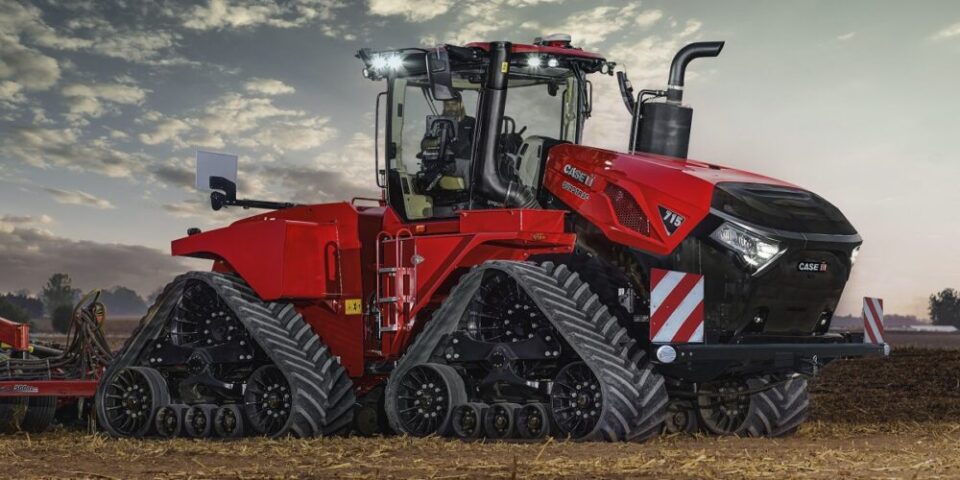
More than six decades after the first Steiger tractor was built, the platform has evolved from a high-horsepower machine designed to meet the demands of large-scale farming into an advanced tractor system combining power, traction, hydraulics, automation and precision technology.
The first Steiger was built in 1958 after farmers in North America began looking for greater pulling power for increasingly demanding field operations. The concept was simple: build a tractor capable of handling heavy workloads while delivering the durability and traction needed in challenging conditions.
That basic requirement has remained, but the technology behind it has changed dramatically.
From Mechanical Power to Integrated Technology
As farms expanded and implements became larger, increasing horsepower alone was no longer enough. Tractors needed more efficient power transmission, stronger hydraulic systems, improved operator environments and better control.
Steiger tractors progressively incorporated developments in transmissions, hydraulics, electronics and cab design. These changes helped turn the tractor from a primarily mechanical power source into a more sophisticated platform capable of managing increasingly complex field operations.
In 1986, Steiger became part of Case IH, bringing the technology into a broader agricultural machinery portfolio.
The Quadtrac Transformation
A major step in that evolution came in 1996 with the introduction of the Case IH Steiger Quadtrac.
Instead of using conventional wheels, Quadtrac introduced four independently driven tracks. The design increased the contact area between the machine and the ground, helping improve traction and flotation while distributing the tractor’s weight over a larger area.
The independently driven tracks also allow high engine power to be transferred efficiently to the ground, particularly during demanding tillage and other high-draft operations.
The four-track configuration became one of the defining technologies of the Steiger platform and remains central to its design today.
The 715-HP Steiger
The latest generation shows how far the platform has developed.
The Steiger 715 Quadtrac produces 715 rated horsepower and up to 778 maximum horsepower. It is powered by a 16-litre six-cylinder engine and paired with a PowerDrive 16-speed full powershift transmission.
The machine produces up to 3,356 Nm of torque and uses a high-capacity hydraulic system designed to operate modern, demanding implements.
Its hydraulic system can deliver up to 428 litres per minute, providing the flow required for large implements with multiple hydraulic functions.
The combination of engine output, transmission technology and hydraulic capacity allows the tractor to handle high-demand field operations while maintaining the control expected from a modern agricultural machine.
More Than Horsepower
For today’s high-horsepower tractors, performance is no longer measured by engine output alone.
Traction, power transfer, hydraulic performance, fuel efficiency, soil impact and operator control all contribute to productivity.
The Quadtrac configuration addresses the traction side of that equation by increasing ground contact and reducing the likelihood of wheel slip. The result is a system designed to put more of the engine’s available power to work in the field.
Precision Technology in the Cab
Modern Steiger tractors also integrate digital technology into everyday operation.
Precision guidance, automated steering and turning, ISOBUS connectivity and implement control allow the tractor and attached equipment to operate as a more integrated system.
The AFS Pro 1200 display provides operators with access to machine and precision-agriculture functions from the cab, while connected technologies can provide information about equipment performance, location and operating status.
This shift toward connected machinery is significant. The tractor is increasingly becoming part of a wider digital farming system rather than operating as an isolated machine.
Designed for Large-Scale Operations
The engineering challenge for modern high-horsepower tractors is to combine enormous mechanical capability with precise control.
A machine such as the Steiger 715 must deliver enough power to work with large implements while maintaining traction, managing hydraulic demand and giving operators the information and automation needed to work efficiently.
That requires the integration of several technologies rather than simply increasing engine size.
Six Decades of Development
The Steiger’s evolution reflects the broader development of agricultural machinery.
The early machines were built primarily around the need for more pulling power. Today’s tractors still require substantial horsepower, but they also depend on advanced drivetrains, track systems, hydraulics, electronics, automation and connectivity.
The Steiger 715 Quadtrac represents the latest stage of that progression, combining 715 rated horsepower with four-track traction and a digitally connected operating environment.
After more than 60 years, the fundamental goal remains familiar: deliver the power and traction required to get demanding fieldwork done. What has changed is the technology used to achieve it.