
For decades, dairy management has relied on experience, observation and farm records to guide decision-making. Today, the rapid growth of sensors, automated milking systems, artificial intelligence (AI) and connected farm technologies is creating new opportunities to manage dairy operations more efficiently. The next major breakthrough may be digital twin technology—virtual models that use real-time farm data to simulate, monitor and predict on-farm performance before decisions are made.
What is a digital twin?
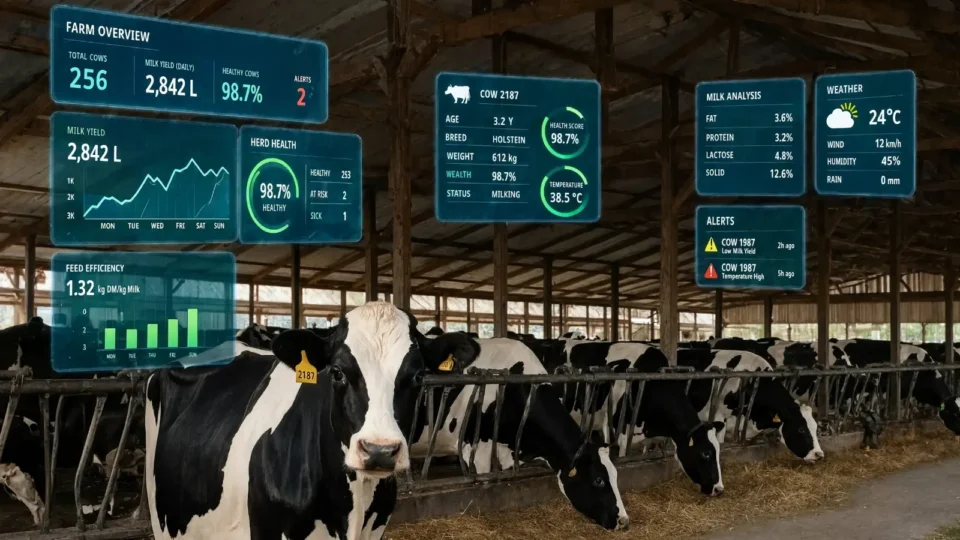
A digital twin is a dynamic digital representation of a physical asset that continuously updates using real-world data. In dairy farming, this could represent an individual cow, a milking robot, a barn or even an entire farm.
Unlike traditional farm management systems that report historical data, digital twins help predict future outcomes. By integrating information from sensors, robotics and management software, they provide producers with a comprehensive view of herd performance, enabling proactive rather than reactive decision-making.
Connecting dairy data for smarter decisions
Modern dairy farms already generate vast amounts of information through robotic milking systems, activity monitors, rumination sensors, cameras and herd management platforms. The challenge is no longer collecting data but transforming it into meaningful insights.
Digital twins combine these diverse data streams into a single intelligent model, helping producers understand how nutrition, health, reproduction, labour, economics and environmental conditions interact across the entire farm.
This holistic approach allows farmers to evaluate management strategies before implementing them, reducing uncertainty and improving operational efficiency.
Why dairy is ideal for digital twin technology
The dairy industry is well positioned to adopt digital twins because much of the required infrastructure is already in place. Connected technologies continuously collect production and behavioural data, creating the foundation for predictive farm management.
Recent digital twin applications have demonstrated more than 90% accuracy in recognising feeding and rumination behaviour, while some studies report 15–20% improvements in feed conversion efficiency and water savings of up to 40%. Small improvements at the individual animal level can translate into significant gains across an entire herd.
Rather than simply identifying problems after they occur, digital twins enable producers to model changes in feeding strategies, labour allocation, herd expansion and infrastructure investments before they are introduced.
Driving the next generation of precision dairy farming
Several companies are already developing technologies that contribute to digital twin ecosystems.
Nedap has introduced SmartSight, an AI-powered vision platform that detects early signs of lameness by monitoring subtle changes in cow movement.
Connecterra focuses on integrating farm data to provide practical, AI-driven insights that help farmers understand what has changed, why it happened and what actions to take next.
Meanwhile, CATTLEytics expands digital farm management by incorporating workforce coordination, communication and financial performance alongside livestock monitoring.
Platforms such as AgriTwin and Farm Mind are also creating continuously updated digital profiles for individual cows by combining genetics, nutrition, health, reproduction and milk quality data to support precision feeding and performance optimisation.
From monitoring to prediction
Digital twin technology is also advancing sustainability research. Scientists are developing digital rumen models capable of simulating feed and microbial interactions to evaluate methane reduction strategies before they are applied on-farm.
Beyond animal management, digital twins are increasingly being used to model business decisions. Technologies from companies such as ElectroMech Agri and BouMatic Apollo allow producers to simulate herd expansion, robotic milking investments, labour requirements, feed demand and cash flow before committing capital.
A new era of intelligent dairy management
As dairy farms become increasingly connected, digital twins are expected to become the intelligence layer that links sensors, robotics, AI and farm management systems into a unified decision-support platform.
The technology represents a shift from simply monitoring farm performance to predicting outcomes and optimising decisions before they are made. By combining real-time data with advanced analytics, digital twins have the potential to improve productivity, profitability, animal welfare and sustainability, positioning them as one of the most promising innovations shaping the future of precision dairy farming.