

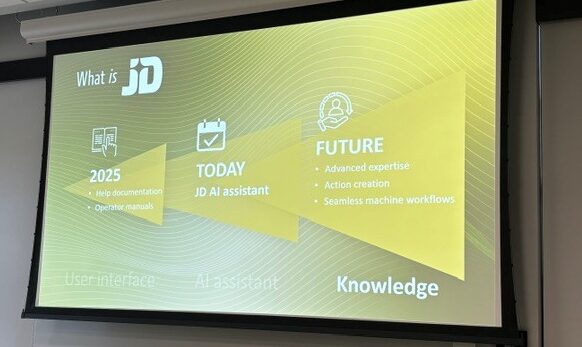
John Deere has introduced JD, an artificial intelligence (AI) assistant integrated into its Operations Center platform. The new tool is designed to help farmers analyze their digital farm data more quickly and use those insights to make operational decisions.
JD allows farmers to interact with field, machine, and farm operation data using natural-language questions. Instead of manually navigating through large amounts of information, users can ask JD questions and receive responses based on data specific to their operation.
“Farmers have more data available to them than ever before, but the value comes from their ability to use it in the moments that matter,” said Jahmy Hindman, chief technology officer at John Deere. “JD changes the experience from navigating through a sea of data to simply asking it a question.”
How JD Works
JD uses data available through a farmer’s Operations Center account to generate responses and identify operational insights. The assistant is designed to provide information based on a farm’s own historical and operational data rather than relying solely on generalized recommendations.
Farmers can use JD to ask questions such as:
- How did fuel use during tillage compare with the previous three years?
- How did singulation vary across a field, and what impact did it have on yield?
- Which sprayer operator is covering the most acres per hour?
- When is the optimal time to harvest based on historical trends?
By bringing this information together through a conversational interface, JD is intended to make complex farm data easier to understand and act on.
Jackson Baca, group marketing manager of Digital Foundation at John Deere, described JD as an AI assistant designed to help farmers get more value from the data already available in their Operations Center accounts.
The company also emphasized the importance of follow-up questions and continued interaction with the assistant. Rather than treating JD as a tool for answering a single question, farmers can use an ongoing conversation to explore their data and uncover additional insights.
Turning Farm Data Into Actionable Insights
According to John Deere, JD provides an opportunity for farmers to make greater use of data collected over many years. By analyzing historical information alongside current operational data, the assistant can help identify patterns and provide insights that may support decisions related to equipment use, planting, spraying, harvesting, fuel consumption, and crop performance.
Deanna Kovar, president of John Deere’s Worldwide Ag and Turf Division, Production and Precision Agriculture, said the technology is intended to help farmers integrate the data they have accumulated and gain insights more quickly.
The approach reflects a broader shift in precision agriculture toward using AI and data analytics not only to collect information, but also to turn that information into practical recommendations.
Farmers Remain in Control of Their Data
John Deere also highlighted data control and transparency as JD becomes more deeply integrated into farm operations.
The company said farmers should remain in control of their data, understand how their information is used, and receive clear value from the insights generated from it.
“Farmers receive value from their data when they can use it to make better decisions, and we believe that value should come with control, transparency and choice,” Kovar said.
JD Early Access Program
John Deere is opening an early access program for JD, allowing customers to express interest in participating.
The AI assistant is expected to become more broadly available through Operations Center on the web and mobile, with integration eventually extending to the G5 in-cab display interface.
With JD, John Deere is combining conversational AI with precision-agriculture data to give farmers a simpler way to access information about their fields, equipment, and operations. The technology could make increasingly large volumes of farm data more accessible and useful for day-to-day decision-making.