

Agriculture across Africa is under increasing pressure to improve productivity, manage labour constraints, reduce crop losses, and make better use of available resources. As farms expand and harvesting windows become more demanding, automation, precision agriculture, and real-time data are becoming increasingly important to modern farming operations.
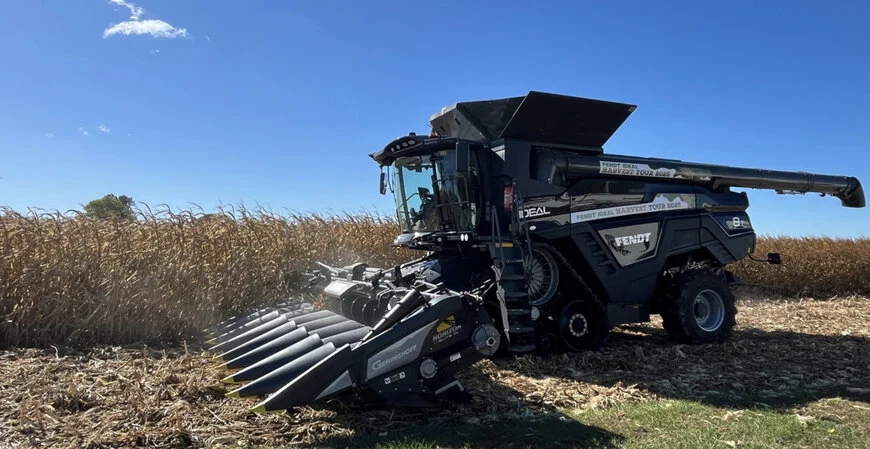
A recent demonstration by AGCO during the 2026 Fendt Harvest Tour in the United States highlighted how connected combine harvesters, autonomous tractors, and digital farming platforms can work together to improve harvesting efficiency.
Conducted from 12 to 22 October 2026 across six US agricultural states, the tour covered eleven farming operations and demonstrated technologies designed to coordinate grain harvesting, automated grain transport, and real-time crop data collection.
Although the demonstration took place in the United States, its underlying principles offer valuable insights for African commercial grain producers seeking to improve operational efficiency and adopt more data-driven farming practices.
1. Understanding the Technology Behind Automated Harvesting
Modern combine harvesters do more than cut and thresh crops. Increasingly, they use sensors, automated controls, and connected digital systems to monitor machine performance and optimise harvesting operations.
The Fendt IDEAL combine harvester demonstrated several technologies designed to improve operator visibility, crop processing, and harvesting efficiency.
IDEALdrive: Improving Operator Visibility
The IDEALdrive steering system replaces the conventional steering wheel and steering column with an electro-hydraulic joystick interface.
This design improves forward visibility from the operator’s seat, potentially making it easier to monitor the header, crop flow, and field conditions during harvesting.
For large-scale African farming operations, improved visibility and reduced physical steering effort can support operator comfort and more efficient machine operation during long harvesting shifts.
IDEALharvest: Sensor-Driven Crop Processing
The IDEALharvest automation system uses sensor information to help optimise the combine’s internal crop-processing settings.
These adjustments include rotor speed, concave clearance, and cleaning fan speed. Acoustic sensors monitor crop-processing conditions to help the system respond to changes in harvesting performance.
The objective is to balance grain quality, harvesting throughput, and grain loss.
This capability is particularly relevant when harvesting conditions vary across a field due to differences in crop maturity, moisture content, yield potential, or crop density.
By automating selected machine adjustments, farmers can reduce the need for constant manual intervention while maintaining greater consistency in harvesting performance.
High-Capacity Grain Unloading
The Fendt IDEAL combine demonstrated during the tour has a reported grain-holding capacity of 485 bushels and an unloading rate capable of emptying the tank in approximately 81 seconds.
Rapid unloading helps reduce the time spent transferring grain from the combine to a grain cart or transport vehicle.
For African farms harvesting large areas of maize, wheat, soybeans, and other grain crops, reducing unloading delays can help keep harvesting equipment productive during short weather windows.
Actual performance will depend on crop conditions, machine configuration, operating practices, and the capacity of the supporting grain-handling system.
2. Autonomous Tractors and Grain Transport
One of the most significant aspects of the demonstration was the integration of the combine harvester with autonomous field logistics.
AGCO demonstrated its PTx OutRun autonomous technology controlling a tractor and grain cart operating alongside the harvester.
The system is designed to coordinate the movement of the grain cart with the combine during harvesting. As the combine unloads grain, the tractor and cart can collect the harvested material and transport it towards the field perimeter.
This reduces the need for a dedicated operator to manually drive the grain cart during the operation, subject to the system’s operating requirements and supervision arrangements.
For large African commercial farms, where harvesting productivity depends on keeping combines moving, coordinated grain transport could help reduce waiting times and improve equipment utilisation.
However, practical deployment would require consideration of field conditions, machinery compatibility, connectivity, operator training, maintenance support, and the availability of suitable autonomous equipment.
3. Precision Agriculture and Real-Time Data Integration
Automation becomes even more valuable when harvesting equipment can collect and share useful operational data.
During the Fendt Harvest Tour, Precision Planting YieldSense 20|20 monitoring technology was highlighted for collecting yield information as harvesting progressed.
Yield monitoring allows farmers to examine differences in crop output across individual passes and locations within a field. When combined with accurate positioning and appropriate calibration, this information can help create yield maps showing spatial variations in productivity.
These maps can support decisions about:
Fertiliser application and nutrient management.
Seed selection and planting strategies.
Irrigation planning where applicable.
Identification of consistently underperforming areas.
Evaluation of field management practices and input costs.
For African farmers, these insights can be valuable where soil fertility, rainfall distribution, irrigation availability, and crop performance vary significantly across the same farm.
Reliable data collection and interpretation are essential. Yield monitors must be correctly calibrated, and the resulting information should be considered alongside soil tests, rainfall records, input applications, and other relevant farm data.
4. Connected Farm Management and Artificial Intelligence
The demonstrated technology ecosystem also incorporates digital farm management tools.
AGCO’s Panorama platform brings together relevant machine and agricultural data to support operational monitoring and decision-making. The tour’s reported integration included the Aurora artificial intelligence assistant for consolidating spatial analytics and helping users interpret information across farm operations.
Connected platforms can help farm managers understand machine performance, track field-level results, and identify operational issues that require attention.
For larger farming businesses operating multiple combines, tractors, and grain transport units, centralised information can improve coordination between machinery, field teams, and management.
Across Africa, the usefulness of these platforms will depend on factors such as mobile network coverage, offline functionality, data costs, equipment compatibility, local technical support, and the availability of reliable digital infrastructure.
Farmers should also evaluate data ownership, subscription costs, and integration with their existing farm management systems before investing.
5. What Does This Mean for African Agriculture?
Africa’s agricultural sector is diverse, ranging from smallholder farms to large commercial grain enterprises. As a result, automated harvesting technologies will not be equally suitable or affordable for every operation.
Nevertheless, the principles demonstrated during the Fendt Harvest Tour offer several practical lessons.
Improving Labour Productivity
In areas where experienced machinery operators are difficult to recruit or retain, automation can help reduce repetitive tasks and improve the efficiency of available labour.
However, autonomous equipment still requires appropriate supervision, maintenance, and trained personnel.
Reducing Grain Losses
Sensor-based harvesting adjustments can help operators manage crop-processing performance and reduce avoidable losses.
This is particularly important where grain losses directly affect farm profitability and food availability. Actual improvements depend on crop conditions, correct machine settings, and operator practices.
Making Better Use of Harvesting Windows
Harvesting is often constrained by rainfall, crop maturity, and limited periods of suitable field conditions.
Faster unloading and better coordination between combines and grain transport equipment can help reduce delays and improve the use of available harvesting time.
Supporting Data-Driven Decisions
Yield mapping and machine telemetry can help farmers move beyond estimating field performance from visual observations alone.
Over time, reliable field data can support more informed decisions about inputs, field management, machinery investment, and crop profitability.
Adapting Technology to Local Conditions
Before investing in advanced automation, African farmers should assess whether the expected productivity gains justify the purchase, operating, training, connectivity, and maintenance costs.
For some operations, the most practical starting point may be a calibrated yield monitor, basic machine telemetry, improved grain logistics, or precision-guidance technology rather than a fully autonomous harvesting system.
6. Operational Impact: From Harvesting Machines to Connected Systems
The wider significance of automated harvesting lies in the integration of multiple technologies rather than in any single machine.
Combining sensor-driven crop processing, automated grain transport, yield monitoring, and digital farm management creates an interconnected system that can help farmers improve visibility across their operations.
The reported 81-second grain unloading performance illustrates the importance of reducing transfer delays, while yield monitoring and machine data can provide insights into field productivity and equipment utilisation.
However, the benefits of these technologies should be evaluated using measurable farm-level indicators, including grain losses, tonnes harvested per hour, fuel consumption per tonne, labour requirements, downtime, and total operating costs.
During the tour, Kevin Forth, Senior Tactical Marketing Manager at AGCO, emphasised the importance of performance during the harvesting season:
“Harvest is where a full year of work comes together, and it is where Fendt technology proves itself in the moments that matter most.”
His observation reflects a central challenge for farmers everywhere: harvesting technology must deliver practical value when timing, weather, and crop quality matter most.
Conclusion: The Future of Smart Harvesting in Africa
Automated combine harvesters, autonomous grain transport, precision yield monitoring, and connected farm management platforms represent an important direction in agricultural technology.
The 2026 Fendt Harvest Tour demonstrated how these technologies can work together to coordinate harvesting operations, improve machine efficiency, and generate useful crop performance data.
For African agriculture, the opportunity lies in adopting these innovations strategically. Large commercial grain farms may benefit from integrated automation, while other producers may achieve meaningful gains through incremental improvements in precision farming, machinery management, and grain logistics.
Ultimately, successful agricultural technology adoption is not simply about purchasing advanced machinery. It is about selecting solutions that suit local farming conditions, strengthening technical skills, measuring performance, and ensuring that the investment delivers sustainable economic value.
The future of smart harvesting in Africa will depend on combining the right technology with local knowledge, reliable support, and data-driven farm management.