

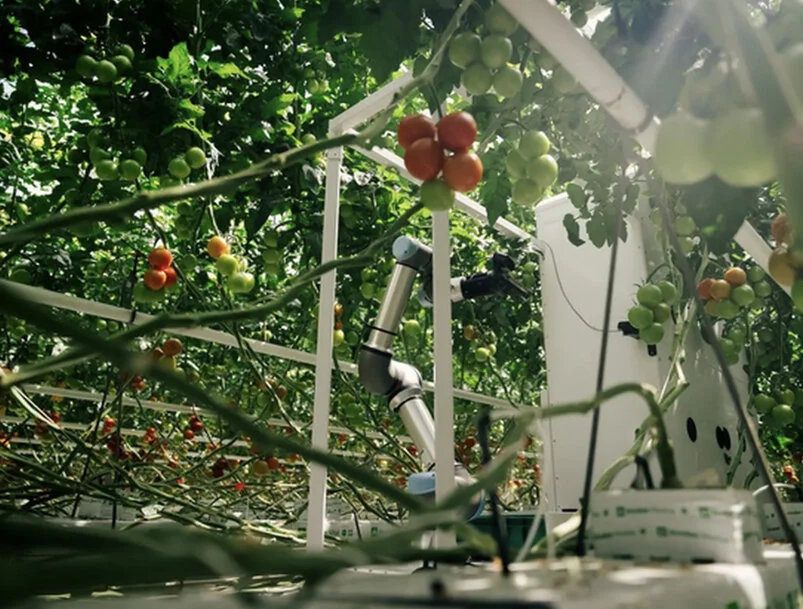
AI-Powered Harvesting Robots Aim to Transform Greenhouse Farming
Autonomous harvesting technology is emerging as a potential solution to labour challenges in greenhouse farming, helping growers improve operational efficiency, maintain crop quality and support more predictable production.
As African agriculture faces growing pressure from climate variability, rising input costs and the need to produce more food efficiently, controlled-environment agriculture is gaining attention. Greenhouses can help farmers manage growing conditions and produce fresh vegetables throughout the year, although labour availability and operating expenses remain important challenges.
Collaborative Robots Automate Greenhouse Harvesting
To address these challenges, eternal.ag has integrated its autonomous harvesting solution with Universal Robots UR5e collaborative robots in greenhouse environments.
The system combines artificial intelligence (AI), computer vision and robotic control to identify and harvest crops with precision. These technologies are designed to support delicate harvesting operations while helping protect plant health and maintain produce quality.
For greenhouse operators, automated harvesting could help reduce the amount of repetitive manual work required, particularly during labour-intensive production periods.
Virtual Simulation Speeds Up Robot Development
A key feature of the technology is its simulation-first development approach. Engineers can train, test and validate robotic movements in a virtual environment before deploying the system in a physical greenhouse.
According to eternal.ag, this approach can reduce development time from months to weeks, allowing robotic systems to be tested and refined more efficiently before real-world use.
The solution uses Universal Robots UR5e collaborative robots, which feature integrated safety functions and precise motion control. These capabilities are designed to support tasks that require careful handling, such as harvesting tomatoes, while allowing robots to work alongside human staff under appropriate safety arrangements.
Sherry Kunjachan, co-founder and chief technology officer at eternal.ag, highlighted the benefits of the simulation-based approach, explaining that it enables the engineering team to train, test and validate robots virtually, significantly shortening development cycles.
What This Could Mean for African Greenhouse Farmers
For Africa’s growing horticulture sector, robotic harvesting could offer new opportunities to improve productivity, particularly for commercial greenhouse operations supplying supermarkets, food processors, hotels and export markets.
However, adoption across African markets will depend on several practical considerations, including the cost of robotic equipment, access to reliable electricity and connectivity, technical skills, maintenance support and the availability of spare parts.
Farmers will also need to consider whether their greenhouse layouts, crop varieties and production volumes are suitable for automated harvesting. For smaller operations, the initial investment may be difficult to justify without sufficient production scale or access to financing.
Robotic harvesting is therefore likely to complement, rather than immediately replace, human labour in many African farming environments. Workers could increasingly focus on crop monitoring, plant health, quality control and other farm management activities as automation takes over selected repetitive tasks.
Towards Smarter and More Efficient Agriculture
The integration of AI, computer vision and collaborative robotics demonstrates how automation could support the next generation of greenhouse farming.
For African producers, these technologies present a potential pathway towards more consistent production, improved labour efficiency and stronger competitiveness in domestic and export markets. Their long-term impact will depend on making the technology affordable, practical to maintain and adaptable to the diverse conditions of African agriculture.