

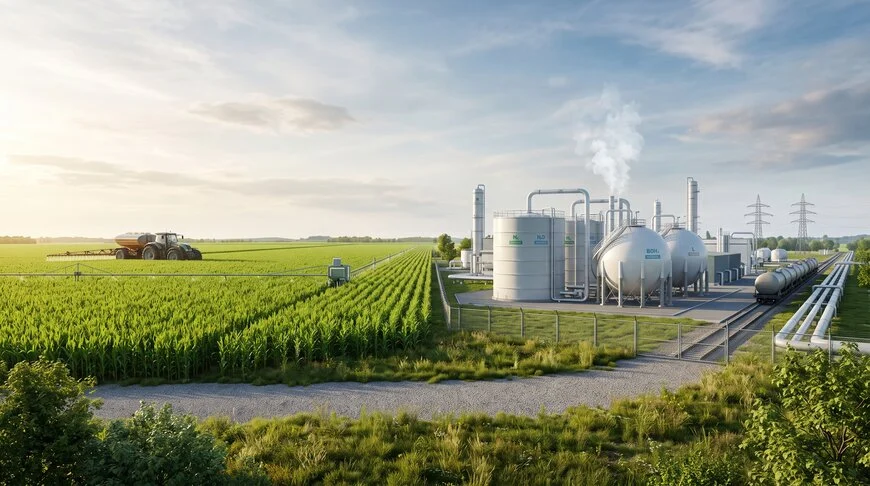
KBR’s Purifier® ammonia technology has been selected for two major fertilizer-related developments in Argentina and Saudi Arabia, highlighting the role of advanced chemical processing technology in expanding industrial fertilizer production and supporting global food security.
The projects involve Pampa Energía’s planned ammonia-urea complex in Argentina and a new ammonia plant for SABIC Agri-Nutrients in Jubail, Saudi Arabia. Both developments are designed for high-volume production, with the potential to strengthen regional fertilizer supply chains and support agricultural productivity.
High-Capacity Ammonia Production
In Argentina, KBR will provide technology licensing, a basic engineering design package and proprietary equipment for Pampa Energía’s planned ammonia plant, which is designed to produce 3,430 metric tonnes of ammonia per day. The facility forms part of an integrated ammonia-urea complex in Bahía Blanca, with operations expected to begin by the end of 2029.
In Saudi Arabia, SABIC Agri-Nutrients has selected KBR’s Purifier® technology for a new ammonia plant in Jubail. The facility is designed to produce 3,500 metric tonnes of ammonia per day and is expected to increase the company’s urea production capacity from 4.8 million to 7.4 million metric tonnes annually.
The Saudi Arabian project also includes technology licensing, basic engineering, proprietary equipment and catalyst supply, with Samsung E&A serving as the engineering, procurement and construction contractor.
How the Purifier® Process Works
Ammonia is a key raw material in nitrogen-based fertilizer production, particularly urea, which is widely used in commercial agriculture. Its manufacture involves combining hydrogen and nitrogen under controlled pressure and temperature in the presence of a catalyst.
KBR’s Purifier® process incorporates cryogenic purification to remove impurities, including methane and argon, from synthesis gas while adjusting the hydrogen-to-nitrogen ratio for ammonia synthesis. This helps reduce the concentration of inert gases in the synthesis loop and can improve energy efficiency and plant performance.
For fertilizer manufacturers, process efficiency is important because energy consumption, feedstock costs, equipment reliability and production capacity all influence the cost of ammonia and downstream fertilizer products.
Relevance to African Fertilizer Production
These developments are relevant to Africa, where reliable access to affordable fertilizers remains an important consideration for agricultural productivity, food security and industrial development.
Countries investing in domestic fertilizer manufacturing could benefit from evaluating modern ammonia synthesis technologies when planning new facilities or upgrading existing plants. However, the suitability of any process depends on factors such as natural gas availability, electricity and utility costs, water supply, infrastructure, financing and access to agricultural markets.
Large-scale ammonia and urea facilities can support local fertilizer supply chains, but their commercial viability depends on effective project execution, competitive production costs, distribution networks and dependable access to farmers.
For African industrial operators, engineers and project developers, advances in ammonia synthesis technology provide useful benchmarks for evaluating plant capacity, energy efficiency and long-term operating performance.
Supporting Industrial and Agricultural Development
The selection of KBR’s Purifier® technology for the two projects demonstrates continued investment in high-capacity ammonia production for fertilizer markets.
Although the facilities are being developed outside Africa, their scale and process technology offer relevant lessons for the continent’s fertilizer industry. Future investments in ammonia and urea production will require careful consideration of feedstock security, energy efficiency, environmental performance and the economics of supplying both domestic and regional agricultural markets.