

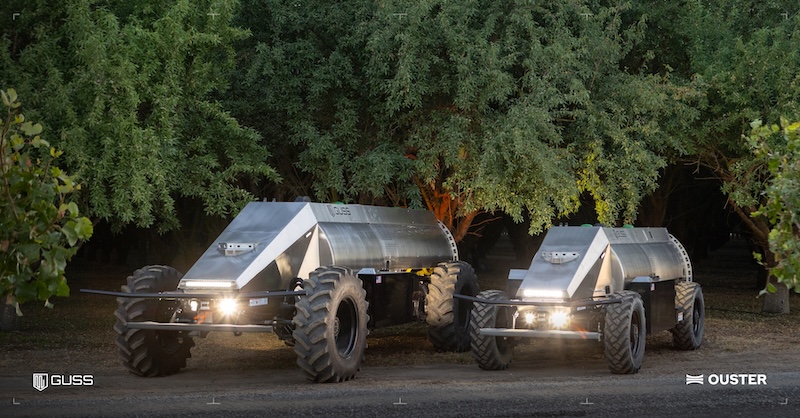
GUSS Automation, a wholly owned subsidiary of John Deere, plans to integrate Ouster’s Rev8 OS0 native-colour digital LiDAR sensors into the next generation of its autonomous orchard machines.
The planned integration is expected to enhance the machines’ ability to navigate complex agricultural environments, particularly dense orchards and vineyards where conventional GPS-based systems may not provide sufficient precision.
LiDAR Improves Machine Perception
High-value crop production presents significant navigation challenges. Dense vegetation, uneven terrain, dust and changing lighting conditions can make autonomous operation more difficult and require advanced sensing technologies.
GUSS plans to use Ouster’s Rev8 OS0 digital LiDAR to provide additional perception capabilities for its autonomous machines. The sensors generate detailed three-dimensional data that can help the machines identify tree trunks, crop rows, ground contours and potential obstacles.
The LiDAR system also provides a wide field of view, supporting navigation across outdoor environments with varying lighting conditions. Its native-colour sensing capabilities are designed to provide additional environmental information for autonomous operations.
Jason Brantley, vice president of production systems, small ag and turf at John Deere, said GUSS is focused on developing autonomous solutions to address the challenges of high-value crop production.
“Integrating advanced sensing technologies into our machines helps support reliable operation in complex orchard environments and provides growers with tools designed to improve productivity and operational flexibility,” Brantley said.
Designed for Harsh Agricultural Conditions
Ouster’s Rev8 sensor platform combines 3D depth data with native-colour imaging and a rugged design intended for demanding outdoor applications.
The planned integration is aimed at environments where autonomous machines may encounter dust, agricultural spray and dense vegetation.
According to the companies, the sensing technology will support autonomous spraying operations involving Orchard GUSS and Mini GUSS machines. A single operator can monitor up to eight autonomous machines simultaneously from a laptop, helping manage spraying operations across permanent crops.
The technology could also have applications beyond spraying. Similar LiDAR-based autonomous systems could potentially support other orchard and vineyard operations requiring navigation, mapping and obstacle detection.
Ouster CEO Angus Pacala said the planned integration represents a step towards expanding the use of digital LiDAR in autonomous agricultural machinery.
The development highlights the growing role of LiDAR, robotics, computer vision and autonomous navigation in precision agriculture, as equipment manufacturers seek to improve the ability of machines to operate safely and efficiently in complex farming environments.